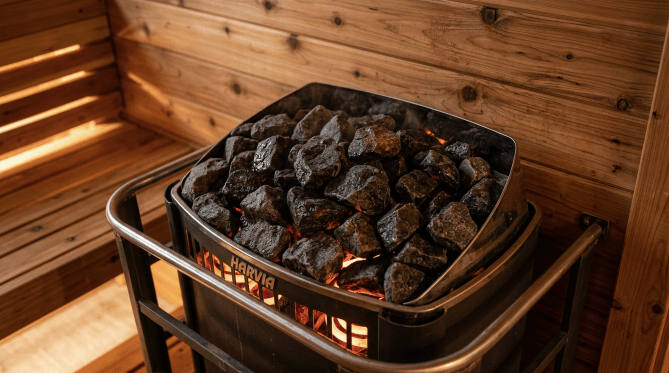
Heat-treated hemlock generally costs 15 to 30 percent less per board foot than western red cedar and holds up better under the direct radiant heat closest to the heater, which makes it the more budget-friendly choice for the wall and bench section nearest the guard rail. Cedar’s advantage is aroma, natural rot resistance, and a warmer, more varied grain, which is worth paying for on the parts of the room people actually see and sit against, rather than across every board.
Where the Price Gap Actually Comes From
Western red cedar carries a premium mostly because of natural rot and insect resistance that makes it useful well beyond sauna construction, in decking and siding as well, which keeps demand and price elevated. Heat-treated hemlock starts as a cheaper raw softwood and gains its heat tolerance through a kilning process, and even with that added processing step it typically still lands below cedar per board foot. For a full small cabin interior, that per-board-foot gap can add up to several hundred dollars across the total wall and bench area, which is real money on a tight sauna heater budget.
Does the Cheaper Wood Actually Hold Up Near the Heat?
This is the good news for a budget build: heat-treated hemlock is not a compromise near the heater, it is arguably the better technical choice there. The kilning process pre-shrinks the wood fibers and drives out moisture and resin before installation, which makes it more dimensionally stable under the highest, most concentrated heat in the room. Cedar can still perform fine in that zone, but owners more often report resin beading or a stronger scent developing there over the first year or two. Choosing hemlock near the heater on a budget is not settling for less durability, it happens to be the more heat-tolerant material as well.
A Practical Budget Layout That Splits the Difference
A common approach for stretching a limited wood budget without the room looking cheap: heat-treated hemlock on the lower bench and the wall section within a few feet of the guard rail, where it is both less expensive and better suited to the heat, and cedar reserved for the upper bench, ceiling boards, or door trim, where people sit longest and where the aroma and color read most clearly. This layout typically captures most of cedar’s visual and scent appeal while keeping the largest surface areas, the lower walls and bench, on the cheaper material.
Comparing Total Room Cost, Not Just Board Foot Price
Board foot pricing alone does not tell the full story, since labor to fit tongue-and-groove paneling is roughly the same regardless of species, meaning the wood cost difference is the whole story on the material side. For a small two to three person cabin interior, expect an all-hemlock build to run meaningfully below an all-cedar one, often several hundred dollars depending on regional lumber prices, while a mixed layout using hemlock for roughly two-thirds of the surface area lands somewhere in between. Checking finished kit pricing that already specifies wood species by section, the way SweatDecks.com lists it on individual product pages, is a faster way to compare real total cost than pricing raw lumber species separately.
What Not to Skimp On, Even on a Tight Budget
Regardless of species chosen, the wood within the manufacturer’s stated clearance of the heater still has to meet that clearance and be rated for sauna use, not a generic exterior softwood bought to save a few more dollars. Untreated construction lumber, even cheap cedar-adjacent species not actually rated for sauna interiors, can off-gas or warp badly under repeated heat cycling in ways that end up costing more to fix than the original savings. The budget move is choosing the cheaper of two properly rated woods, hemlock over cedar, not substituting an unrated material entirely.
Long-Term Value: Does the Cheaper Wood Age Well?
Heat-treated hemlock’s stability advantage tends to hold up over years of use, not just in the first season, since the moisture removal happens once during processing rather than gradually through use. It does typically show less of the color variation and richness that cedar develops with age, so buyers prioritizing looks over cost long term may still lean toward at least partial cedar. For a sauna built primarily to be used rather than admired, hemlock’s practical durability and lower cost make it a reasonable primary material with cedar used selectively where it earns its keep.
What the Research Says About Regular Sauna Use, Regardless of Wood Choice
None of this wood decision changes the underlying case for using a sauna consistently once it is built. A review in Mayo Clinic Proceedings summarized associations between frequent sauna bathing and favorable cardiovascular outcomes across cohort studies. A separate review in the American Journal of Physiology examined the body’s physiological response to sauna-style heat exposure specifically. A systematic review in Evidence-Based Complementary and Alternative Medicine reported broadly similar associations. These are population-level findings, not individual guarantees, and they apply the same whether the walls around the heater are cedar, hemlock, or a mix of both.
See also: Is the FDA Banning Compounded Semaglutide?
What About the Guard Rail and Backrest Specifically?
The guard rail and any backrest slats closest to the heater see the most direct radiant exposure in the room, which is exactly why builders working to a budget still tend to spec rated hardwood or hemlock for these specific pieces even when saving money elsewhere. A backrest that flexes or checks from heat exposure is uncomfortable and eventually needs replacing, so this is a poor place to substitute an unrated species even if the savings look tempting on paper. Treating the guard and backrest as a small, fixed-cost item within an otherwise budget-conscious wood plan keeps the room both cheaper overall and durable exactly where it matters most.
Sourcing Kiln-Dried Stock Without Overpaying
Both cedar and heat-treated hemlock should arrive kiln-dried to a low moisture content suited for sauna interiors, and this is worth confirming with any supplier regardless of which species you choose, since green or improperly dried lumber will warp and gap once the heater starts cycling. Buying from a supplier that specializes in sauna-grade lumber, rather than a general home center stocking exterior-grade boards of the same species, is usually the more reliable way to get correctly dried stock, even if the per-board price looks slightly higher than a big-box alternative that is not actually rated for the job.
Frequently Asked Questions
Which costs less around a sauna heater, cedar or heat-treated hemlock? Heat-treated hemlock is typically 15 to 30 percent cheaper per board foot than cedar.
Is it safe to use a cheaper wood right next to the heater? Yes. Heat-treated hemlock holds up well under direct heat because kilning removes moisture that would otherwise cause warping.
Can you mix cedar and hemlock to save money without it looking cheap? Yes, using hemlock on the lower wall and bench near the heater and cedar on the upper bench or trim keeps costs down while looking intentional.
Does a full cedar room around the heater cost much more overall? For a small cabin, an all-cedar interior can add several hundred dollars over an all-hemlock build.
References
- Effects of heat and cold on health, with special reference to Finnish sauna bathing, American Journal of Physiology, 2018
- Does the Combination of Finnish Sauna Bathing and Other Lifestyle Factors Confer Additional Health Benefits? A Review of the Evidence, Mayo Clinic Proceedings, 2023
- Clinical Effects of Regular Dry Sauna Bathing: A Systematic Review, Evidence-Based Complementary and Alternative Medicine, 2018
By Carla Bevins